













For any business that aims to lower its emissions, carrying out a carbon footprint is a fundamental exercise. In this article, I will cover the basics of carbon accounting, how to conduct a carbon footprint, and the value this will bring your business.
What is a carbon footprint?
A carbon footprint is the total amount of greenhouse gas (GHG) emissions that your business produces.1 The day-to-day running of your business will release GHGs into the atmosphere and there may be multiple sources of emissions, including fuel consumed in company vehicles and the manufacture of products.
The GHG Protocol, which sets the gold standard for companies worldwide to quantify and report their GHG emissions, defines three distinct categories (or ‘scopes’) of emissions. They are as follows:2,3
Scope 1
Direct GHG emissions from sources that your business owns or controls. Potential sources, which can be mobile and/or stationary in nature, are the combustion of fuel in company vehicles and boilers.
Scope 2
Indirect GHG emissions from the generation of purchased electricity, heating, cooling and steam. These occur at sources that your business does not own or control, such as a power station.
Scope 3
Indirect GHG emissions from all other sources along the value chain that your business does not own or control, such as those associated with purchased goods and services.
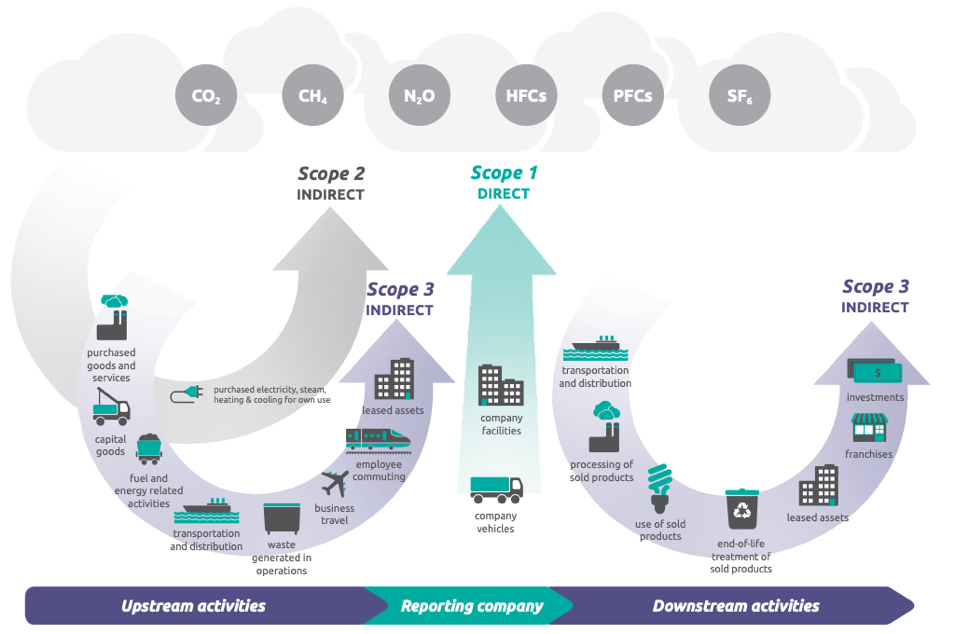
Emission scopes. Source: GHG Protocol Corporate Value Chain (Scope 3) Accounting and Reporting Standard3
Scope 3 emissions are typically the most challenging to calculate, largely because doing so involves collating data from your external partners across your value chain, but they are by far the most important — according to the GHG Protocol, scope 3 emissions can account for over 90% of a company’s carbon footprint. As they tend to make up the largest proportion of emissions, they present the most significant opportunities for a business to achieve large GHG emission reductions, ensuring resources are allocated to where it can have the greatest impact.4
What does a carbon footprint involve?
Following global best practice in the form of the GHG Protocol, the approach to conducting a carbon footprint consists of five key steps:5
1. Reviewing business activities
This first step involves reviewing your business activities, organisational structure, operational sites and other core components relating to how your business functions. This research will inform the next step.
2. Setting emission boundaries
This involves defining the parts of your business — for example, you may have subsidiaries and/or joint ventures, which you have differing levels of control over — and business operations that will form part of the carbon footprint. Deciding on the relevant parts for inclusion establishes what is called an ‘organisational boundary’. Once this has been done, a screening process will be carried out to determine the scope 1, 2 and 3 emission categories that should be included in your carbon footprint; the emission categories that are deemed relevant constitute your ‘operational boundary’.
3. Data collection
By liaising with your internal and external stakeholders, data is collected to calculate your scope 1, 2 and 3 emissions. To calculate emissions accurately, collecting activity data (this comes from specific activities carried out by your business, such as the amount of electricity consumed to power your office spaces) should be the priority, falling back on average and/or spend data if activity data cannot be obtained. An important point to convey here is that carbon footprinting is an iterative process — your first carbon footprint might rely heavily on spend data, but with time, your data collection processes will improve, yielding a more accurate carbon footprint.
4. Emissions calculation
After collecting relevant data, emissions can be calculated. Emission factors will be collated from established and reliable sources (such as the UK Government’s GHG database), which enable the conversion of all the data you collected in the previous step into GHG emissions.
5. Identifying emission hotspots
By analysing the results of your carbon footprint, the largest sources of emissions can be identified. These are known as ‘emission hotspots’. Most attention should be given to addressing emission hotspots to achieve the largest GHG emission reductions.
Why should my business carry out a carbon footprint?
Quantifying your emissions can have many benefits for your business:
Achieving net zero
By understanding your emissions impact, you can set emission reduction targets — your first carbon footprint can be the baseline for these targets to measure progress against — to achieve net zero in line with climate science (i.e. by no later than 2050).
Meeting stakeholder expectations
Although your business may only have a small carbon footprint, your employees, suppliers, customers and other key stakeholders may expect you to measure and disclose your emissions. Failing to do so may therefore negatively affect your reputation and/or brand image.
Talent attraction
A growing number of younger people also care about how businesses are supporting the global fight against climate change, so inaction may make your business less attractive to talent; in fact, a recent survey of over 23,000 people found that 70% of Gen Z and millennials consider a company’s environmental credentials when choosing an employer.6
Legal requirement
Your business may also be legally required to disclose emissions data; with the effects of climate change only worsening with time, it is likely that regulatory pressure will increase.
There are many other reasons to care about carbon footprinting, but I hope these give you a flavour of the potential risks and opportunities that are associated with it.
Final reflections
Carbon footprinting is the cornerstone of any credible approach to achieving net zero. By revealing the most emission-intensive parts of your business, you will be able to allocate resources efficiently and maximise your positive impact. Aside from reducing your GHG emissions to support the environment, measuring and disclosing your emissions can help meet regulatory demands, identify cost-saving opportunities, and strengthen relationships with your key stakeholders.
At Elder Environmental, we can help you to build a comprehensive picture of your emissions profile. If you’re unsure where to start, book a free 30-minute call and we’ll work it out together.
References
- British Business Bank — How to measure your carbon footprint
- GHG Protocol — Corporate Standard
- GHG Protocol — Corporate Value Chain (Scope 3) Standard
- GHG Protocol — Scope 3 Detailed FAQ
- GHG Protocol — Corporate Standard
- ISEP Global — Seven in 10 Gen Z adults consider green credentials when choosing employer